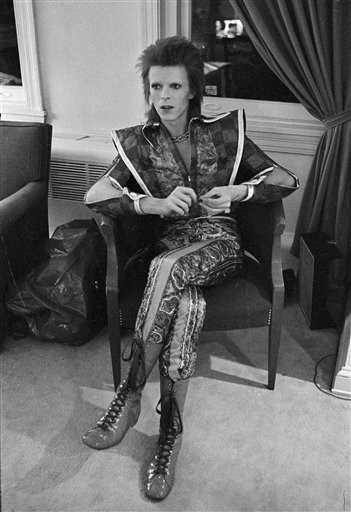
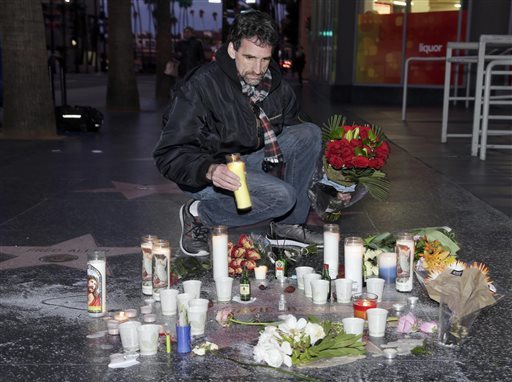
David Bowie, the infinitely changeable, fiercely forward-looking songwriter who taught generations of musicians about the power of drama, images and personas, died Sunday, two days after his 69th birthday.
Bowie’s death was confirmed by his publicist, Steve Martin, on Monday.
He died after having cancer for 18 months, according to a statement on Bowie’s social-media accounts.
“David Bowie died peacefully today surrounded by his family,” a post on his Facebook page read.
His last album, “Blackstar,” a collaboration with a jazz quartet that was typically enigmatic and exploratory, was released Friday —his birthday. He was to be honored with a concert at Carnegie Hall on March 31 featuring the Roots, Cyndi Lauper and the Mountain Goats.
He had also collaborated on an off-Broadway musical, “Lazarus,” that was a surreal sequel to his definitive 1976 film role, “The Man Who Fell to Earth.”
Bowie wrote songs, above all, about being an outsider: an alien, a misfit, a sexual adventurer, a faraway astronaut.
His music was always a mutable blend: rock, cabaret, jazz and what he called “plastic soul,” but it was suffused with genuine soul. He also captured the drama and longing of everyday life, enough to give him No. 1 pop hits like “Let’s Dance.”
Yet throughout Bowie’s metamorphoses, he was always recognizable. His voice was widely imitated but always his own; his message was that there was always empathy beyond difference.
Born David Robert Jones on Jan. 8, 1947, in South London, Bowie was a person of relentless reinvention. He emerged in the late 1960s with the voice of a rock belter but with the sensibility of a cabaret singer, steeped in the dynamics of stage musicals.
Angst and apocalypse, media and paranoia, distance and yearning were among Bowie’s lifelong themes. So was a taste for transgression coupled with a determination to push cult tastes toward the mainstream.
Bowie produced albums and wrote songs for some of his idols — Lou Reed, Iggy Pop, Mott the Hoople — that gave them pop hits without causing them to abandon their individuality. And he collaborated with musicians like Brian Eno in the Berlin years and, in his final recordings, with the jazz musicians Maria Schneider and Donny McCaslin, introducing them to many new listeners.