
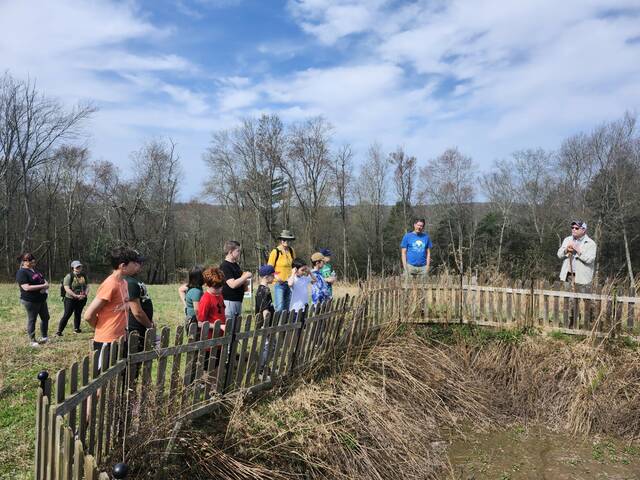
Christine Leandri’s gifted class from Wyoming Area Middle School gathers around a rain garden at the Lehman Sanctuary, where Sanctuary director Chris Miller, at far right, explains how the garden helps keep pollutants out of the pure water in the wetlands at the Sanctuary.
Mary Therese Biebel | Times Leader
Students enter natural world of Lehman Sanctuary
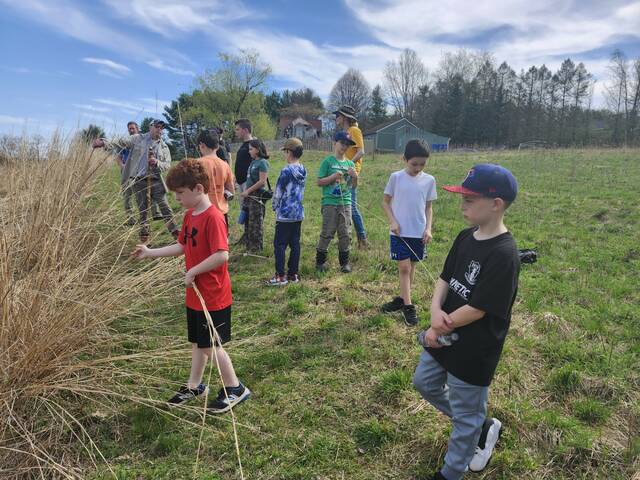
At the urging of Lehman Sanctuary founder Christopher Miller, visiting students, including Francis Warenda, Karl Kiwak and Owen Griffith, examined some dry prairie grass, which will grow up to 7 feet tall and have a complex root system that restores aquifers underground.
Mary Therese Biebel | Times Leader
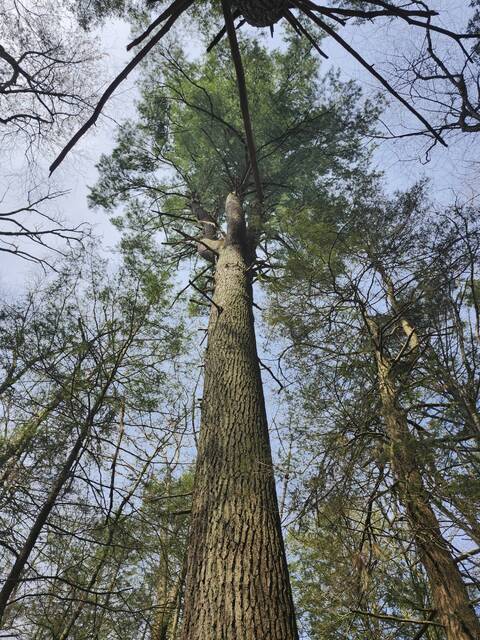
A towering white pine at the Lehman Sanctuary is an example of an old growth tree. Sanctuary founder Christopher Miller told the visiting students it is more than 250 years old, and therefore older than the United States itself.
Mary Therese Biebel | Times Leader
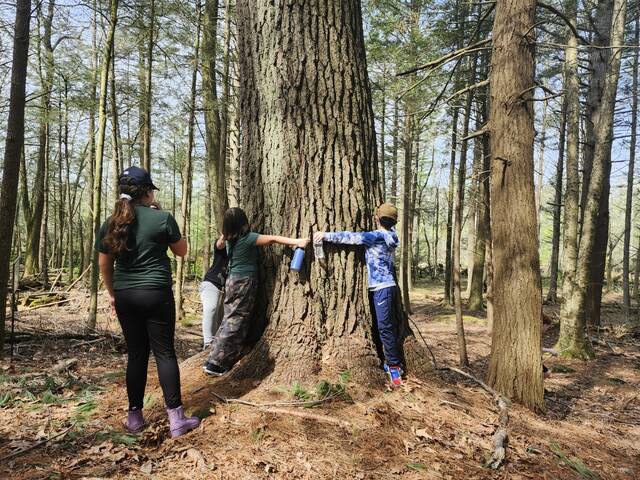
How many third, fourth and fifth graders does it take to stretch around a huge tree? Alexis Mikielski, Maverick Fabbri and some friends want to find out.
Mary Therese Biebel | Times Leader

Wyoming Area students gather around King’s College professor Garrett Barr, at lower right, who is showing them an amphibian he found at the Lehman Sanctuary. The children found amphibians, too, and everyone released the little animals after gently examining them.
Mary Therese Biebel | Times Leader
As Christine Leandri and her students from Wyoming Area’s gifted program stood admiring a very tall, very old, white pine, Christopher Miller asked a question:
“How old is our country?”
“250 years!” a boy called out.
“This tree has been here for at least that long. It’s older than the United States of America,” said Miller, founder of the non-profit, 18-acre Lehman Sanctuary in Lehman Township, where teachers and other interested individuals are welcome to arrange a visit.
“I’m wondering how many third, fourth and fifth graders it would take to reach around the tree,” Sanctuary volunteer John Ferrante said.
Soon Alexis Mikielski, Maverick Fabbri and another friend were stretching, finger to finger, trying to form a circle around the thick trunk on a recent Thursday morning. It looked like completing the circle would take more than three people … but already most of the other students were further along the path in the old-growth forest.
Some of the water on the ground was ephemeral, Miller told them, explaining that means it’s not always there. “It’s also known as spring seeps or vernal pools,” he said. “What do you think it’s good for?”
“For drinking.”
“Water for plants.”
“For salamanders.”
“You’re all right,” Miller told the youngsters who had supplied the answers. The ephemeral water was especially good for salamanders, he said, because there would be no predators, such as fish, in it. And the young visitors were welcome to search for salamanders.
“One rule I have for you all is, if you move a rock or a log, you must put it back where you found it,” Miller said. “Gently put it back.”
Of course, they also were to gently release any salamanders they found.
“This place is wonderful,” teacher Christine Leandri said. “It’s a hidden gem.”
Helping the children experience nature first hand on their recent field trip were King’s College associate professor of biology Garrett Barr, who found several salamanders and a wood frog for them to examine, and John Ferrante, a retired forester, who was eager to talk about trees.
“This is my favorite tree,” Ferrante said at one point, pointing to a slender young birch that was growing out of a fallen hemlock. A seed likely fell into a crack in the fallen tree, he said, and it started to grow, under the bark. Now, as the new tree continues to grow, the old tree will eventually decay underneath it, leaving an empty space. The new tree will then appear to be walking on stilts, Ferrante said.
The young students already knew a lot about the natural world, even before their visit, as they proved by answering questions Miller posed. They knew the sheltering roof of tall trees in the forest is called a canopy. They knew that pollinators help food to grow. They knew some trees are conifers (cone bearing) and some are deciduous (annually lose their leaves).
But there’s nothing like being out in nature to learn, Ferrante said. “Your eyes are better than any camera. Your brain is better than a computer. You can sense things through your fingers.”
Before they entered the old growth forest with its towering pines and hemlocks, the students passed through a meadow that Miller expects will be colorful with wildflowers in a month or so. They admired a fenced-in rain garden which is designed to keep stormwater from the road — with its remnants of oil, gas, road salt and other pollutants — away from the pristine water of the wetlands.
The children also stopped to admire some dry prairie grass, a species that Miller said will grow to be about 7 feet tall this summer. Under the ground, meanwhile, its roots will grow 13 to 15 feet in an intricate system that encourages aquifers, or natural reservoirs.
“Your generation is going to be very concerned about clean water,” Miller said.
To arrange a visit to the Lehman Sanctuary, contact lehmansanctuary@gmail.com or call 570- 406-2639.